The California Association of Bicycling Organizations (CABO; CABObike.org) strongly opposes SB 569 (Blakespear), as amended June 11. This bill appears to be an overreaction to a local dispute.
SB 569 bill prevents the removal of physical separation on existing bikeways without a unique, extensive, and enormously detailed technical analysis and public process that would, in practice, be prohibitive, or perhaps impossible, to provide. No other roadway design feature enjoys similar protection. Nor is there any requirement for a corresponding technical justification when bikeways (or other design features) are installed. This asymmetry would severely limit the ability of local agencies to modify bikeways after gaining experience with their usage and safety. It might even, no doubt contrary to the author’s intent, discourage the provision of bikeways that, once installed, would be effectively locked in permanently.
In addition, the bill’s language is confusing and ambiguous, referring to “physical separation” of Class I, II, III, and IV bikeways, when only Class IV bikeways, as defined in Streets and Highways Code §890.4, actually feature physical separation. Class I bikeways are shared-use paths, completely apart from the roadway. Class II bikeways are bike lanes established on the roadway, indicated by a painted stripe or buffer, but not a physical separation. Class III bikeways, or bike routes, are simply roadways designated by signs or markings as particularly suitable for bicyclists. Only Class IV bikeways, also called cycle tracks or separated bikeways, involve physical separation using flexible posts, rigid barriers, or similar devices.
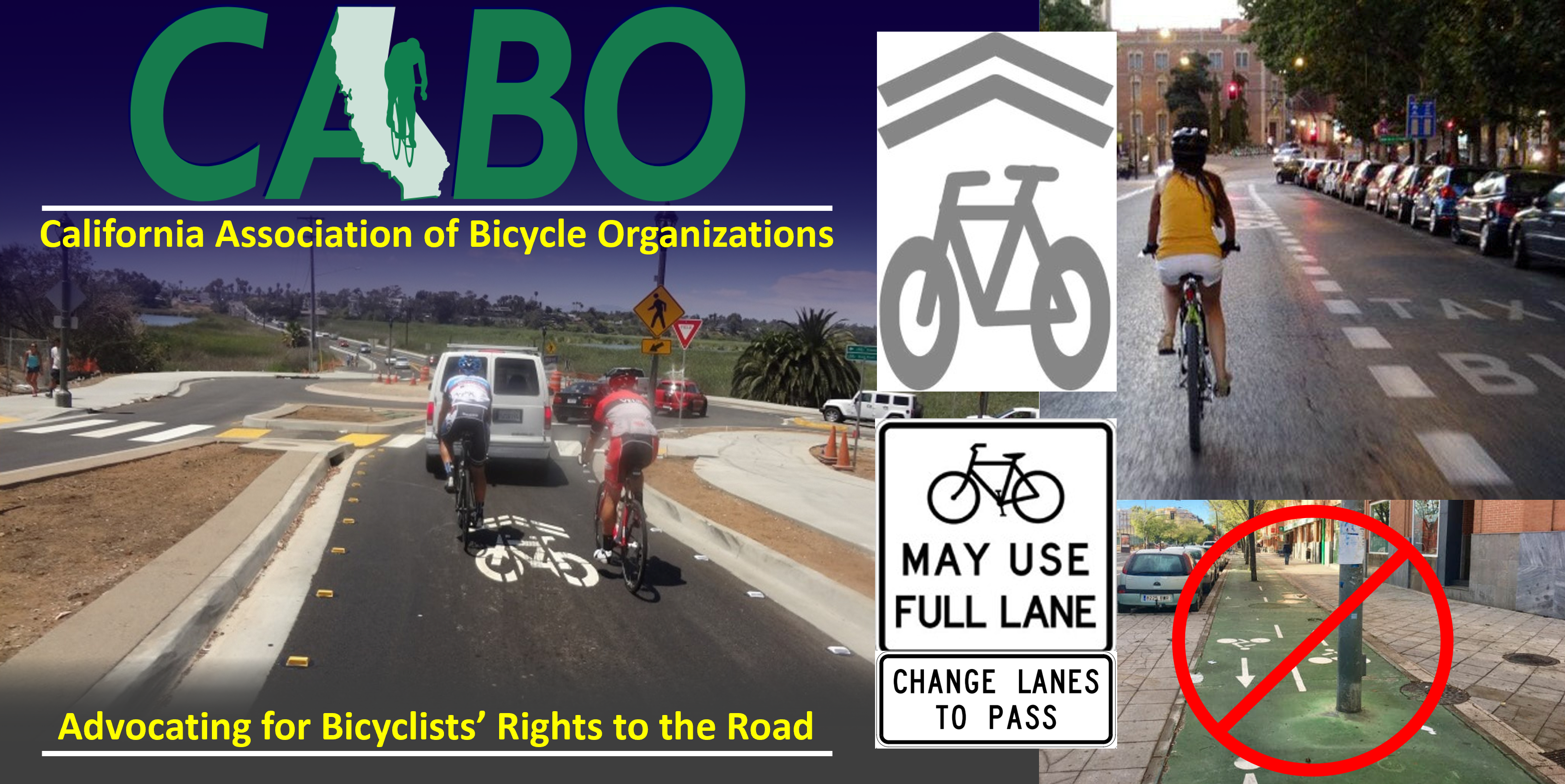
The bill also refers to a Class III bikeway that “is” or “is not” a sharrow. But a Class III bikeway is a designated roadway, and a sharrow, or shared lane marking, is a roadway marking. They are in no way equivalent. And neither involves physical separation.
This bill is a hastily offered solution to a problem that does not exist and could create widespread unintended consequences. For these reasons, CABO must oppose it, and we urge the Transportation Committee to do the same.